


The Painted Ranch and the Wraith Ledger - a Cautionary Tale
By viewing thewhistleblower.ca you have explicitly agreed to abide by the Terms and Conditions of Use.

In a far valley beneath high mountains stood a ranch whose gate bore a great winged forged-iron letter.
It was a beautiful place. Snow lingered on the distant peaks even when flowers opened in the lower meadows. Horses galloped through the grass with their manes flying. Homebred foals slept beside their brood mares. Smoke rose from a rough-hewn house where a family lived far from the comforts of the towns, making their own way by firelight, hard labour, and stubbornness.
The Keeper of the ranch was a gifted teller of tales.
He sent pictures and stories beyond the valley: of family togetherness, hardships endured and healing found; of storms survived, fences mended, horses tended, and household animals cared for. His wife appeared often at the hearth or in the garden, smiling amid her work, while the Keeper never tired of praising his “fair bride”. His children, now grown, were no longer merely figures in the family tale; they helped tend the ranch and carry their father's stories and pictures beyond the valley. And always there were the horses - “the wild ones”, the Keeper called them - as though they belonged to no man but to the mountains and wind. To feed such creatures seemed almost an act of mercy toward nature itself. To those watching from afar, it was a captivating picture of triumph over adversity, an invitation to feel less like strangers and more like villagers themselves.
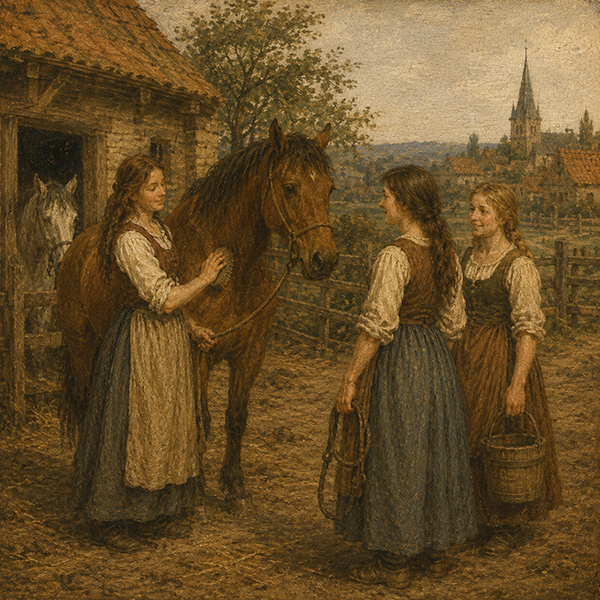 From
time to time young women came from beyond the valley to work as
“wranglers” among the horses. Youthful, long-haired, and at ease
among the horses, they appeared so regularly that they became
familiar figures in the pictures sent abroad. The villagers were
never quite certain what arrangements brought the successive
wranglers to the valley for the privilege of learning the Keeper's
ways.
From
time to time young women came from beyond the valley to work as
“wranglers” among the horses. Youthful, long-haired, and at ease
among the horses, they appeared so regularly that they became
familiar figures in the pictures sent abroad. The villagers were
never quite certain what arrangements brought the successive
wranglers to the valley for the privilege of learning the Keeper's
ways.
The words and pictures appeared to please the villagers greatly. And so,
when the 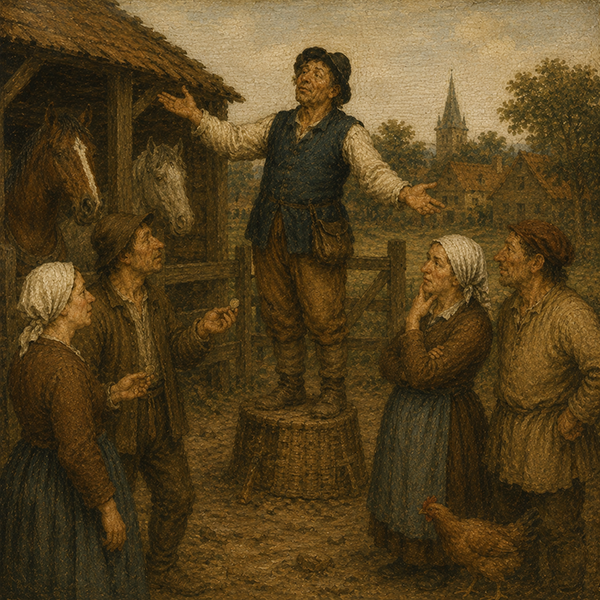 Keeper called to the villagers near and far: “Good people, the wild horses need hay”, and the villagers gave. When another
brood mare required medicine, he called again, “Good people, she
needs our help”, and they gave again. When winter came, there was
another need. When illness came, another. When some particular horse
suffered, its story was carried from cottage to cottage until another
stream of coins found its way toward the gate.
Keeper called to the villagers near and far: “Good people, the wild horses need hay”, and the villagers gave. When another
brood mare required medicine, he called again, “Good people, she
needs our help”, and they gave again. When winter came, there was
another need. When illness came, another. When some particular horse
suffered, its story was carried from cottage to cottage until another
stream of coins found its way toward the gate.
No villager doubted that the Keeper tended those in his charge. The horses appeared fed. Their wounds were treated. Their coats shone in the sunlight. The family, their chickens and their pets appeared well cared for.
But after many seasons, an old woman of the village, known for her wisdom, asked a question. “Why do you call them wild?”
The Keeper seemed puzzled, replying “Because they are wild horses”.
“But the brood mares”, she said, “are they not bred within your herd?”
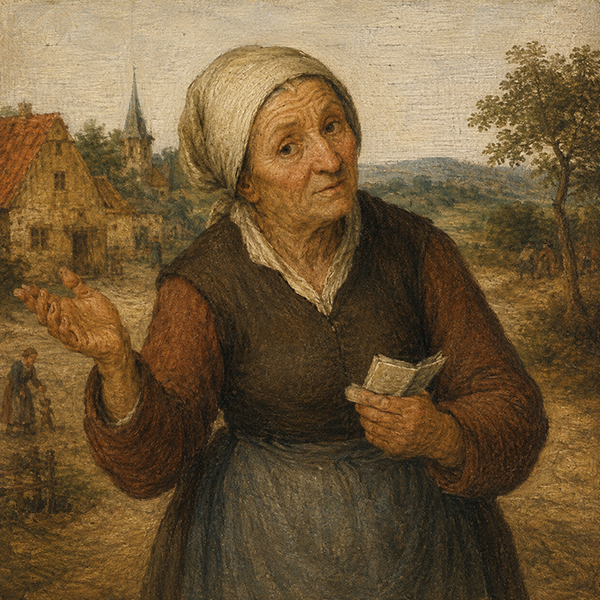 “Yes”, answered the Keeper.
“And their foals were born there?” “That too”, the Keeper admitted.
“And you decide which fields they enter, what and when they eat, which stallion covers which mare, and when a healer is called to attend them?”
The Keeper frowned. “These things must be done for their welfare”.
“Quite so,” said the old woman, nodding. “I question not their care. I merely wonder whether ‘wild’ and ‘rescued’, as you call them, describe the horses or the tales you tell about them.”
Some villagers laughed. Others did not. For they had begun to notice that the words wild and rescue opened purses rather more readily than the word livestock.
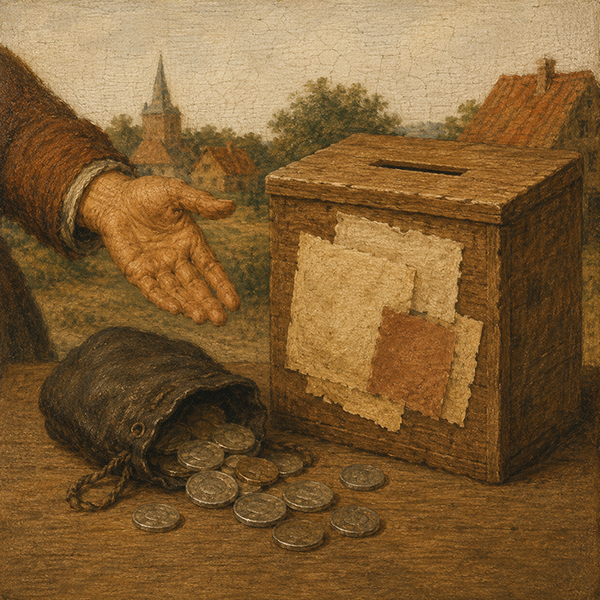 They
noticed something else as well. The Keeper's collection boxes did not
always keep the same names. At first a box might be announced for one
urgent purpose. Some time later, a new appeal would appear with a
different name, although the need beneath the fresh lettering seemed
much the same as before.
They
noticed something else as well. The Keeper's collection boxes did not
always keep the same names. At first a box might be announced for one
urgent purpose. Some time later, a new appeal would appear with a
different name, although the need beneath the fresh lettering seemed
much the same as before.
“Is this a new collection?” asked a villager. “It has a new name”, replied the Keeper.
“That was not the question”, said the old woman as she walked around the box and examined it carefully. “If yesterday's purse has become today's purse”, she said, “then what became of yesterday's balance? Did it follow the new name? Was the first need satisfied? Did anything remain?”
The villagers did not object to a new name. But a growing number began to understand that a fresh inscription upon a box did not necessarily make a fresh purpose beneath it. “If the same purpose continued under a fresh inscription,” said one, “then surely the counting should continue with it.”
Soon thereafter came one of the greatest appeals of all.
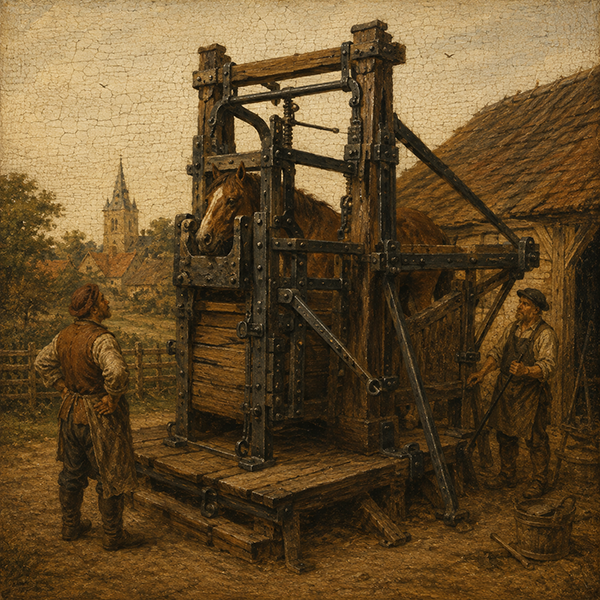 The Keeper told the villagers that the horses desperately needed a
magnificent iron contrivance, custom built with levers and cylinders,
which could hold and gently tilt a great horse so that the healer
might safely tend its feet and body. But it would be costly. Very
costly.
The Keeper told the villagers that the horses desperately needed a
magnificent iron contrivance, custom built with levers and cylinders,
which could hold and gently tilt a great horse so that the healer
might safely tend its feet and body. But it would be costly. Very
costly.
“But think of the horses”, said the Keeper.
So the villagers gave by the handful. A labourer sent the price of an evening meal. A widow sent several coins she had saved for winter. Merchants sent more. Others passed the tale along to distant villages. At length, a considerable treasure had been gathered toward the great iron machine.
The villagers waited eagerly for its arrival. They had seen pictures of nearly everything else at the ranch: newborn foals, broken rails, journeys in the Keeper’s handsome painted carriage, meals, storms, dogs, cats, horses, laughter, mud and sunsets. Surely they would soon see the magnificent new machine.
Spring passed. Then summer. No great iron contrivance appeared. Eventually word came from the smith who had fashioned it that the Keeper had told him to sell it elsewhere.
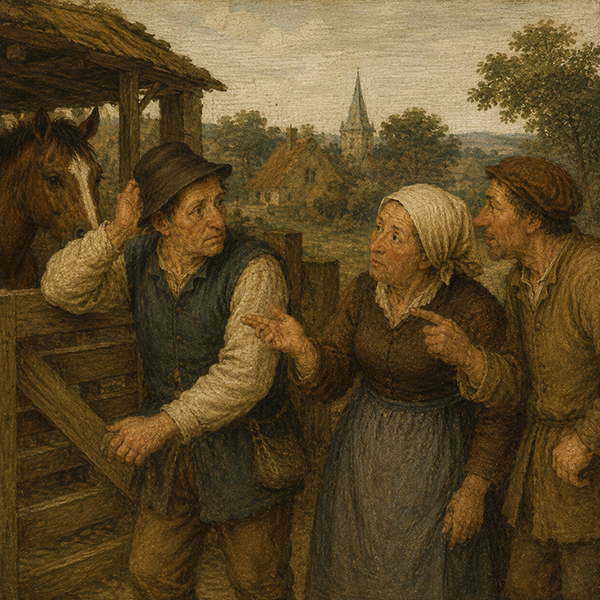 This
puzzled the villagers. “What became of our coins?” asked the old
woman. “Perhaps they had been returned?” asked the broom-maker.
“Perhaps they had been kept safely for the same purpose?” asked
the miller. “Perhaps,” wondered another, “while we slept the
other villagers agreed that the coins might be used elsewhere?”
This
puzzled the villagers. “What became of our coins?” asked the old
woman. “Perhaps they had been returned?” asked the broom-maker.
“Perhaps they had been kept safely for the same purpose?” asked
the miller. “Perhaps,” wondered another, “while we slept the
other villagers agreed that the coins might be used elsewhere?”
Any of these answers might have satisfied reasonable people. But no clear account was laid before them. Instead came more pictures. More horses. More needs. And more appeals for coin.
“The horses look healthy”, said one villager. “That is good”, replied the old woman. “But a healthy horse is not a ledger”.
Around this time the village clerk discovered something else among the parchments.
The ranch, which appeared in the Keeper's tales as the lonely undertaking of one hardy family against the wilderness, was held by a company in which another man held an equal share.
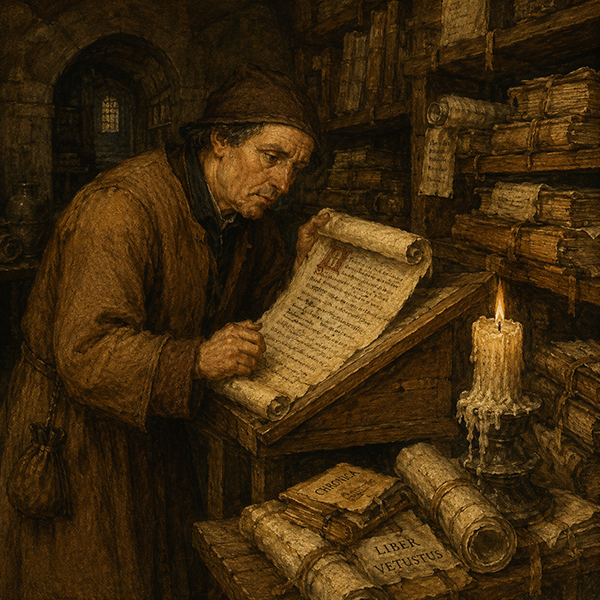 And
while villagers were being asked for small coins for feed, medicine
and machinery, parchments concerning land, shares and control spoke
of a bargain so large that its value was counted not in tens, nor
hundreds, nor thousands, but in millions, a sum the parchments said
was to be paid by the Keeper to the other man.
And
while villagers were being asked for small coins for feed, medicine
and machinery, parchments concerning land, shares and control spoke
of a bargain so large that its value was counted not in tens, nor
hundreds, nor thousands, but in millions, a sum the parchments said
was to be paid by the Keeper to the other man.
No one could properly say from those parchments that the villagers' coins had paid for that bargain.
The old woman was careful about that. “A question is not an answer”, she said. “And the accounts laid before the villagers by the Keeper do not tell us what became of each stream of donated coin. And that”, she said, “was precisely the difficulty.”
“Pennies are asked for at the gate”, she said, “while millions are spoken of in the counting house. Neither proves anything about the other. But surely we villagers, and the other good people beyond the valley who supply their coins, are entitled to know what became of them”.
Then came yet another development. New signboards appeared near the gate. They bore noble words suggesting stewardship, public good and charity. Some villagers rejoiced.
“At last”, they said. “Now everything will become clear”.
But the old woman walked around the new signs and looked behind them. She saw the same valley. The same horses. The same buildings. Many of the same hands. And beyond them stood the same old company's fence.
“A new sign may mark a new road”, she said. “Or it may merely be a new sign”.
“How shall we know?” asked the villagers.
“Find the purses”, she replied. “Who holds them? Who counts them? Who decides where the coins go? And can someone other than the Keeper open them and see inside?”
Many of the generous outsiders, and even some villagers, thought this unnecessarily suspicious. The mountains were still beautiful. The family still looked wholesome. The foals were still delightful. And the Keeper still spoke movingly of hardship, sacrifice and horses.
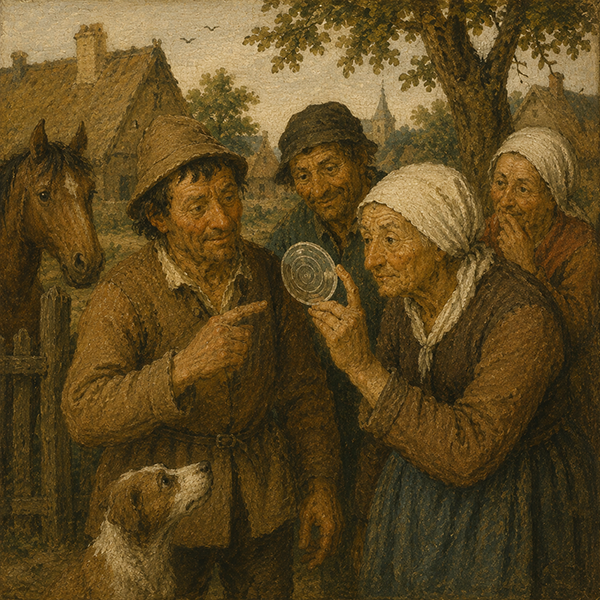 And
then the Keeper showed them a curious object. It was a small clear
disc engraved with a mysterious spiral. He spoke enthusiastically of
remarkable things it might do. Illnesses seemed to retreat before it.
Hurts appeared to mend. Invisible forces were said to pass through it
in ways no village physician had demonstrated. “See,” the Keeper
said, “everyone benefits from these, my family, wranglers, guests,
the horses, our family pets, and even our garden plants!”
And
then the Keeper showed them a curious object. It was a small clear
disc engraved with a mysterious spiral. He spoke enthusiastically of
remarkable things it might do. Illnesses seemed to retreat before it.
Hurts appeared to mend. Invisible forces were said to pass through it
in ways no village physician had demonstrated. “See,” the Keeper
said, “everyone benefits from these, my family, wranglers, guests,
the horses, our family pets, and even our garden plants!”
Some villagers were impressed. Others bought the disc.
The old woman turned it over in her hand. “Where is the medicine?” she inquired. “You cannot see its workings”, the Keeper told her.
“Where are the healers who proved them?” she asked. “They do not yet understand”, he replied.
“Who sells these?” The answer was easier to find.
“And who gains when the villagers buy them?” At that question, the answer again became less clear.
The old woman placed the disc upon the table. “A fine horse does not prove the powers of a little spiral”, she said. “Nor does a beautiful mountain. Nor does a loving family. A man's virtue in one field is not proof of his wisdom in another”.
By now some villagers had begun asking such questions publicly. The Keeper did not always welcome them. Those who questioned too persistently were sometimes spoken of as enemies and malcontents. There were dark tales of those the Keeper called “haters”, and letters from learned men of law appeared.
The Keeper himself told a curious tale of a “mission”, a journey away from the valley, of watching, and of adversaries, as though asking after coins and parchments had somehow transformed neighbouring villagers into foes.
That troubled the old woman more than anger would have. For she knew an ancient trick of disputation: When the question becomes inconvenient, make the questioner the question.
So she called the villagers together beneath the oak beside the market square. “Good people”, she said, “we have made one mistake again and again. We thought that because the mountains were beautiful, the story told beneath them must be equally so. We thought that because a family appeared loving, every business conducted around that family required no examination. We thought that because horses were cared for, every horse called ‘wild’ or ‘rescued’ must therefore be wild or rescued. We thought that because a need was real, every coin gathered in its name must necessarily have been applied to that need. We thought that because a collection received a new name, it must therefore be a new collection. We thought that because a new sign bore a noble word, the purse behind it must necessarily have changed.”
The villagers nodded their heads and murmured in agreement.
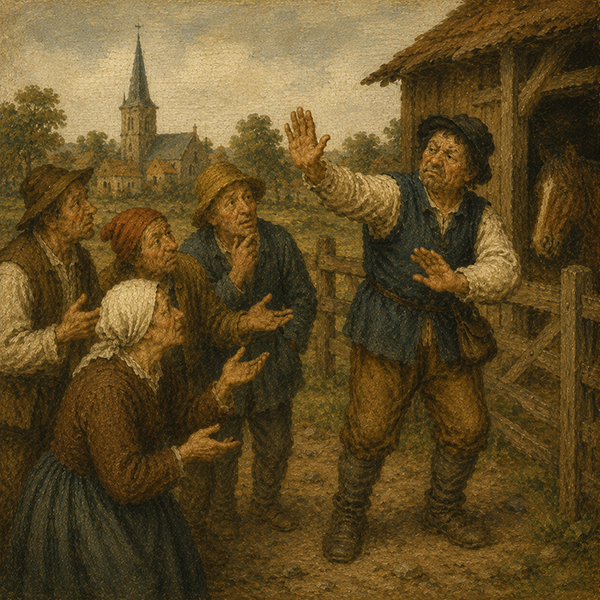 “And
now some among us are shamed by the Keeper, accused of distrust and
plotting, and some even banished after asking what became of the
coins so generously given. This should not be so.”
“And
now some among us are shamed by the Keeper, accused of distrust and
plotting, and some even banished after asking what became of the
coins so generously given. This should not be so.”
The blacksmith stood on his anvil and declared, “An honest account protects both giver and receiver.”
When another message came from the painted ranch, the villagers listened. A mare needed treatment and they felt sympathy. Then someone asked, “Is she one of the wild ones?”
Then it emerged that she was a brood mare of the ranch. There was an awkward silence.
“And the ailing foal and the ridgling?” another villager asked. It emerged that the foal had been born to one of the ranch's own brood mares, and that the ridgling belonged to the ranch as well.
The villagers did not become angry. They did not suddenly cease caring about the animals. A brood mare may suffer as much as a wild one. A homebred foal deserves humane treatment no less than a rescued horse. But the villagers had learned something important.
Compassion does not require confusion.
If they were being asked to help maintain the livestock of an enterprise, they wished to be told so plainly. If they were giving to help a wild or rescued horse, they wished to be shown clearly what evidence supported those words. If yesterday's collection continued beneath today's name, they wished to see the ledger showing what had already been gathered, what had been used and what remained before another coin was requested. And if they were giving for an iron machine, they wished eventually either to see the machine or to be told what became of their coins when the machine did not arrive.
So the villagers continued to admire the valley. They admired the horses. They wished the family well. Some still gave when they believed the cause deserving. But the scenery no longer did the thinking for them. Before reaching for a purse, they began asking simple questions. What exactly is the need? Is this a new collection, or an old collection with a new name? How much was already gathered? Whose animal is this? Who receives the money? What was it spent upon? What remains? Where is the ledger?
And when another villager protested that such questions seemed terribly unkind, the old woman smiled. “No”, she said. “Kindness asks us to open our hearts. Wisdom asks us to open our eyes at the same time and to seek clarity before we part with our coin”.
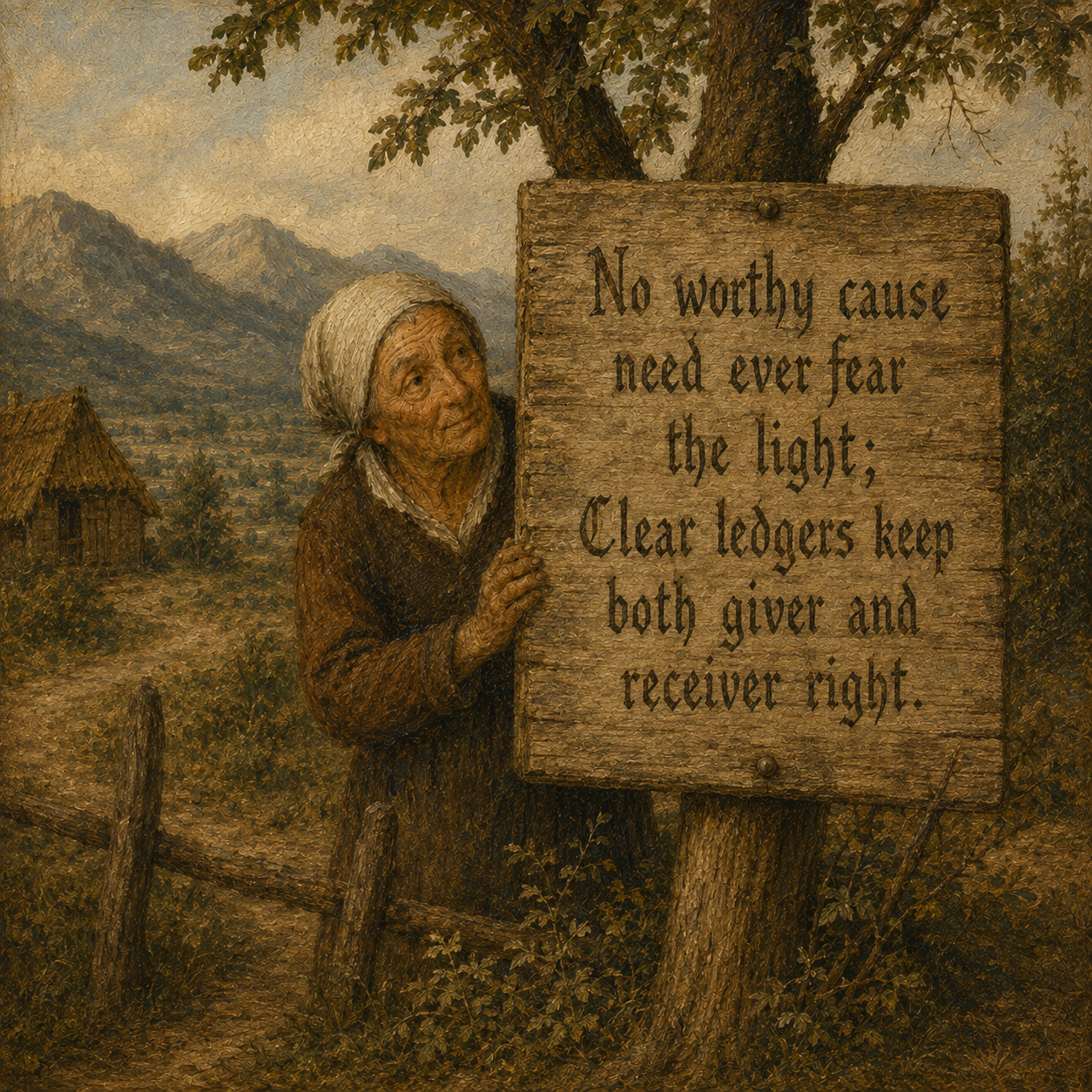
Years later the gate still stood at the entrance to the valley. But another small sign had appeared beside the road, carved by an unknown hand. It bore no accusation. It named no man. It contained only these words:


Here is the PDF version of "The Painted Ranch and the Wraith Ledger - a Cautionary Tale".
 Return to the Humour and Parody page.
August 25, 2026